Understanding Port Saint Lucie's Unique Soil Composition
If you've lived in Port Saint Lucie for any length of time, you've likely noticed that the ground beneath your feet feels different from other parts of Florida. The soil here isn't uniform. Instead, homeowners and contractors work with a complex mix of fine sand, clay layers, and hardpan that can make or break a concrete installation. Understanding what lies beneath your property is the first step toward ensuring your Concrete Driveways remain stable and crack-free for years to come.
The dominant soil type across much of Port Saint Lucie is fine sand, which can range from light tan to slightly darker shades depending on the specific location. This fine sand is highly permeable, meaning water drains through it quickly. While good drainage sounds beneficial, it can actually present problems for concrete foundations. Fine sand offers minimal compaction and poor load-bearing capacity compared to clay or other consolidated soils. When a heavy concrete slab sits on improperly prepared fine sand, the material can shift and settle unevenly over time, leading to the cracks and surface issues that many homeowners discover months or even years after installation.
Sandy Soil and Slab Settling: Why Your Driveway May Be Sinking
One of the most common problems Port Saint Lucie Concrete encounters is uneven settling in driveways installed over sandy soil. When concrete is poured directly onto fine sand without proper preparation, the weight of the slab gradually compresses the sand beneath it. This compression isn't always uniform. Areas that receive more weight, or where the sand is looser, settle faster than surrounding zones. The result is a driveway that appears to have sunken in certain spots, creating trip hazards and an uneven surface that collects water and debris.
The key to preventing sandy soil slab settling is preparation. Before any concrete is poured, the subgrade must be properly excavated, graded, and compacted. Professional contractors use heavy compaction equipment to compress the fine sand to proper specifications. A stable base layer, often consisting of crushed limestone or recycled asphalt, is then laid down and compacted again. This creates a firm, load-bearing foundation that resists the gradual compression that occurs over months and years. Without these steps, even the thickest, highest-quality concrete will eventually show signs of settlement and distress. If you're noticing signs of settling in your existing driveway, Concrete Repair & Resurfacing options are available to restore the surface and prevent further damage.
Hardpan Layers and Their Impact on Drainage and Stability
Beneath the fine sand in many areas of Port Saint Lucie, contractors often encounter hardpan, a dense, cemented layer of sand and clay that has become compacted over time. Hardpan can be anywhere from a few inches to several feet below the surface, and its presence significantly affects how water moves through the soil and how stable a concrete foundation will be. In some cases, hardpan is beneficial. A solid hardpan layer can provide excellent support for a concrete slab, preventing the kind of settlement that occurs in pure sand. However, hardpan also prevents water from draining downward, which can create pooling and saturation issues.
When hardpan sits close to the surface, water cannot percolate down through the soil. Instead, it moves laterally or sits above the hardpan layer, creating a perpetually moist subgrade. This moisture weakens the concrete from below, accelerates freeze-thaw cycles (though less common in Florida), and can promote the growth of mold and algae on the surface. Additionally, if hardpan is struck during excavation and not properly broken up or managed, it can create an uneven foundation. A skilled concrete contractor in Port Saint Lucie will probe the subgrade, identify hardpan layers, and adjust the preparation method accordingly. This might involve breaking through shallow hardpan, adding perforated drainage layers, or adjusting the thickness and composition of the base material to ensure both stability and proper water management.
Swale Driveway Apron Cracking: Managing Storm Water Around Your Concrete
Port Saint Lucie's flat terrain and high water table mean that drainage swales, shallow channels designed to direct storm water away from homes and structures, are common features of residential landscaping. A swale runs alongside or near a driveway apron, directing runoff toward retention areas or storm drains. While swales serve an important purpose, they can create unique stress on concrete. The constant movement of water, the occasional saturation of soil adjacent to the driveway, and the freeze-thaw cycles (rare but possible) all contribute to swale driveway apron cracking.
Cracks often appear at the edge of the driveway closest to the swale because the soil beneath that section experiences different moisture and compaction conditions than the rest of the slab. Water accumulation in the swale can seep under the driveway edge, softening the subgrade and allowing the concrete to flex and crack. To prevent this, proper grading and a stable transition between the swale and the driveway apron are essential. The concrete should be slightly elevated at the edge to shed water away from the swale rather than toward it. Additionally, a permeable or semi-permeable base layer can help manage moisture without allowing saturation. If you're already experiencing cracks near a swale, professional Concrete Repair & Resurfacing can seal cracks, prevent further water infiltration, and extend the life of your driveway.
Concrete Repair in Port Saint Lucie: Addressing Soil-Related Damage
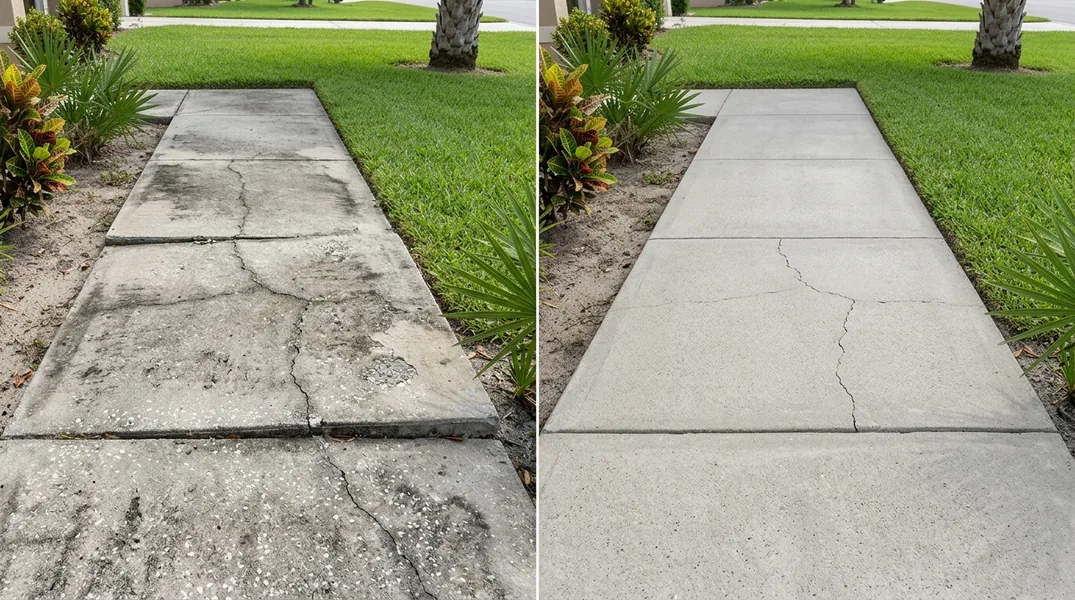
Soil conditions don't just affect new installations. If your existing driveway or patio is showing signs of damage related to Port Saint Lucie's unique ground composition, repair is possible. Common issues include settled sections, edge cracking near swales, and surface spalling caused by moisture penetration. The first step is a professional assessment to determine whether the damage is cosmetic or structural. Minor cracks can often be sealed to prevent water infiltration. Larger settled sections or severely cracked areas may require partial removal and re-pouring, or in some cases, a complete resurfacing.
Port Saint Lucie Concrete specializes in diagnosing soil-related concrete problems and recommending the most cost-effective repair solution. Whether your issue stems from sandy soil settlement, hardpan complications, or swale-related moisture, a professional evaluation is the smartest starting point. The team can assess your subgrade, identify the root cause of damage, and recommend repairs that address not just the symptom but the underlying soil condition. Call (772) 877-0254 today to schedule a free estimate and learn more about your options.
Best Practices for New Concrete Installation on Port Saint Lucie Soil
If you're planning a new Concrete Driveways, Concrete Patios, or other concrete project in Port Saint Lucie, working with a contractor who understands local soil conditions is critical. Best practices begin with a site evaluation that includes soil testing, drainage assessment, and identification of hardpan or other subsurface features. The subgrade should be excavated to the proper depth, graded to encourage drainage away from structures, and compacted in layers to achieve the specified density. A quality base material, typically crushed limestone or recycled asphalt, should be added and compacted separately.
The concrete itself should be properly mixed, poured at the right air temperature and humidity, and finished to provide a smooth, slightly sloped surface that sheds water. Proper curing is also essential, especially in Port Saint Lucie's warm, humid climate. A well-cured concrete slab is stronger and more resistant to moisture penetration and surface deterioration. If your project includes decorative elements, Stamped & Decorative Concrete can be applied over a properly prepared base to add aesthetic appeal without compromising durability. When you partner with Port Saint Lucie Concrete, you're choosing a team that has worked with local soil conditions for years and knows exactly how to build concrete that lasts. Contact us at (772) 877-0254 or visit our website to discuss your project and get a free estimate.
Looking for a professional concrete contractor in Port Saint Lucie? Port Saint Lucie Concrete responds fast for all your concrete needs.
Get a Free QuoteOur services: Concrete Driveways · Concrete Patios · Stamped & Decorative Concrete